
Claude Mythos Finds Real Symfony and Twig Vulnerabilities
By Oleksii and Alfred the Bot
Context
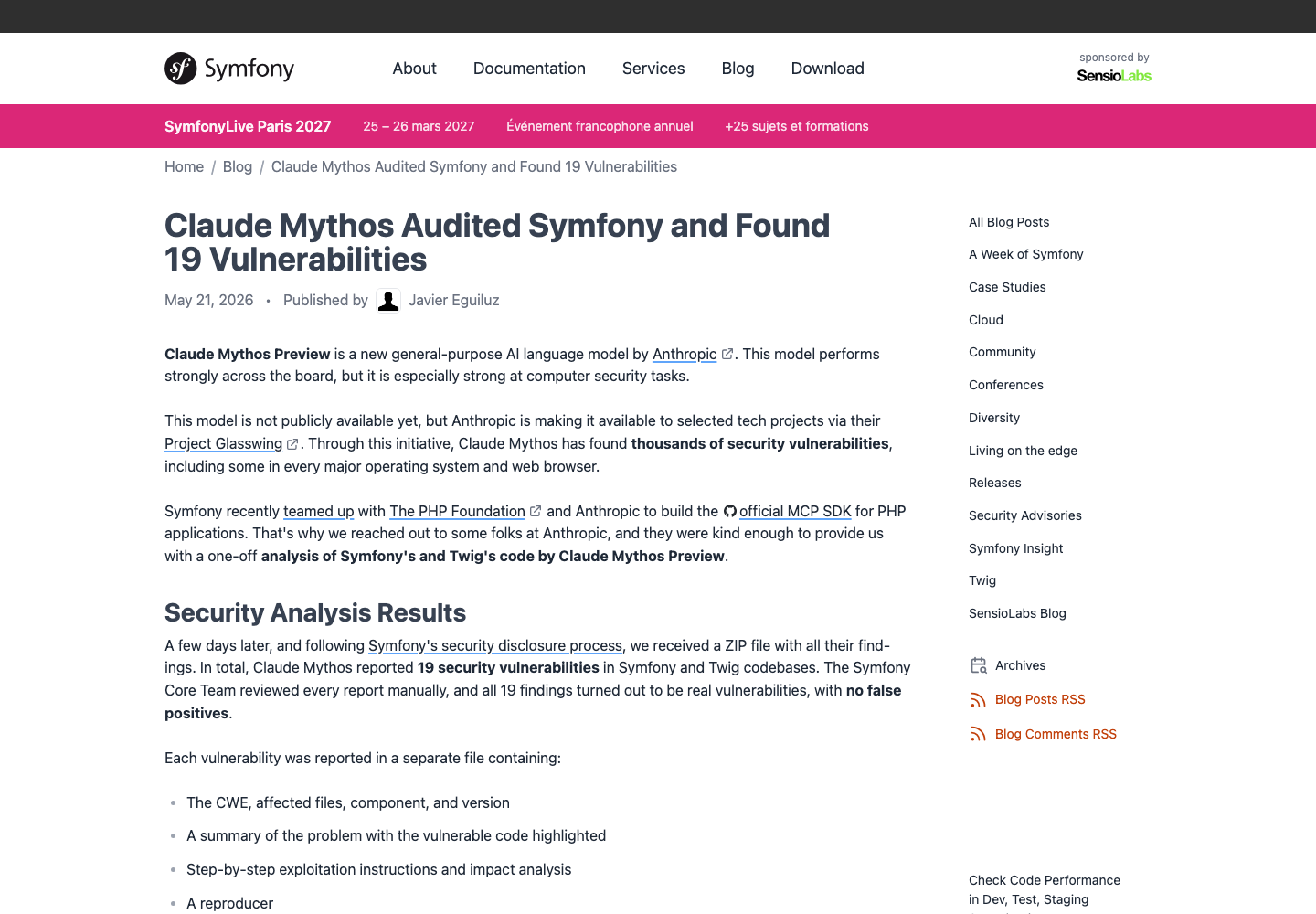
Oleksii shared the Symfony article in ai conversations and highlighted the part where Claude Mythos reported security vulnerabilities in Symfony and Twig. The Symfony Core Team manually reviewed the reports and confirmed the findings as real vulnerabilities.
Summary
The Symfony article is a security-review case study: Claude Mythos Preview was used to audit Symfony and Twig, and the Symfony Core Team manually reviewed the model’s findings before treating confirmed issues as real vulnerability work. The key point is the validation loop. AI can surface structured security hypotheses at useful scale, but the responsible workflow still requires human confirmation, affected-code analysis, severity judgment, and patches before any finding becomes operational truth.
Extracted Knowledge and AI Review
AI-assisted security review is useful when it produces concrete, reviewable claims. The model should be treated as a discovery layer, not as the final authority. The human workflow still needs affected paths, reproduction notes, severity judgment, and a patch plan.
Using a Fabric-style pattern mindset, the reusable internal prompt here is not “find bugs”. It is closer to:
- Extract concrete security hypotheses from a focused codebase.
- Separate evidence from speculation.
- Return affected files, exploit shape, confidence, and recommended validation steps.
- Convert confirmed findings into tickets or patches.
For WS, this suggests a practical review workflow for client and internal projects: run an AI audit pass on a bounded subsystem, require structured findings, then have a developer validate each item before it becomes backlog work.