

Claude Updates and the Next Step for Agent Workflows
By Oleksii and Alfred the Bot
Context
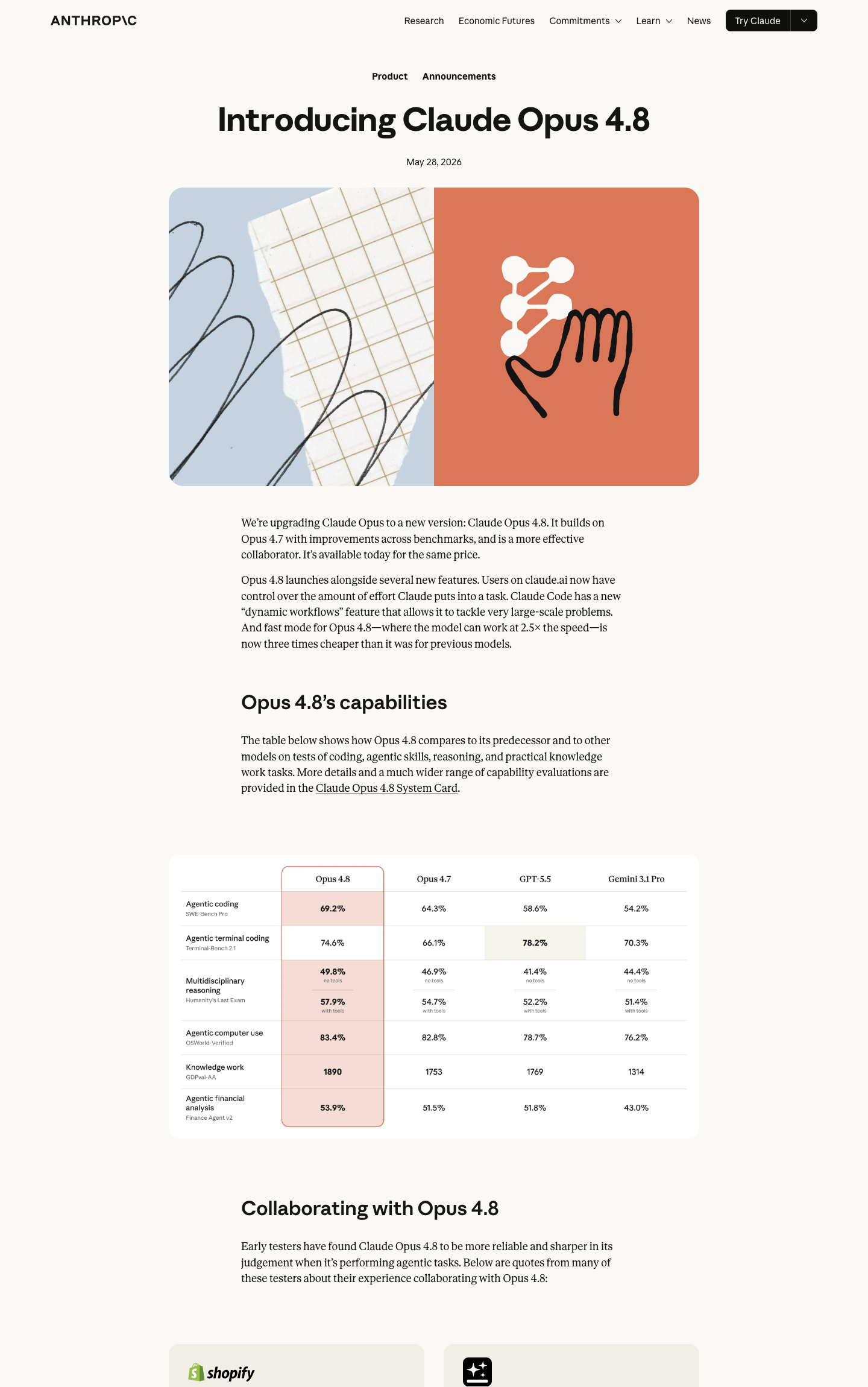
Oleksii shared the Claude Opus 4.8 link in ai conversations, followed by a note about a new /workflows feature and attached examples. The working interpretation is that workflow support is becoming a key product layer around coding agents.
Summary
Anthropic’s Claude Opus 4.8 announcement presents the model as a stronger collaborator for coding, agentic tasks, reasoning, and practical knowledge work, while keeping the same base price. The release also introduces product-layer changes around effort control, cheaper fast mode, Messages API instruction updates, and Claude Code dynamic workflows for larger-scale problems. For WS, the important takeaway is that model quality and workflow packaging now need to be evaluated together: a better model helps, but a better model wrapped in repeatable team workflows is the real leverage.
Extracted Knowledge and AI Review
The Anthropic page frames Claude Opus 4.8 as a stronger collaborator for agentic work and mentions Claude Code’s dynamic workflows for larger-scale problems. That maps directly to the agency use case: repeatable processes need to live as workflows, not as fragile one-off prompts.
Daniel Miessler’s Fabric is a useful reference model here because it treats prompts as reusable units for real-world tasks. That is the missing layer between “ask Claude something” and “run a repeatable team process”.
A WS workflow should therefore have:
- A clear job: research, decompose, summarize, audit, compare, publish, or review.
- Inputs and outputs that teammates understand.
- A source trail, including links, screenshots, commits, and changelog entries.
- A visible review point before something becomes public.
- Versioned prompts or workflow definitions that can improve over time.
The AI review: this is the right direction for WS Daily too. The daily site should not just summarize chat. It should turn chat into structured team knowledge using stable patterns: extract insights, review the topic, preserve source context, and publish only after the shape is good enough.